Amidst the olive groves on the French island of Corsica, a church service has taken place to mark the 60th anniversary of the death of the novelist and World War II hero Antoine de Saint-Exupery.
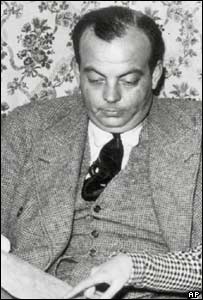
Saint-Exupery is best known as the author of The Little Prince
|
Saint-Exupery had taken off from Corsica for a reconnaissance trip over occupied France.
He disappeared, and no trace of his plane was ever found.
But suddenly this year, the French government announced the discovery of Saint-Exupery's plane - and grave - in the sea near Marseille.
One of the greatest enigmas of aviation - and 20th Century literature - had been solved.
The news should have brought closure to the story of Saint-Exupery. But it has stirred up deep emotions in France.
I first came to Corsica three years ago when I was researching a book. I wanted to recreate Saint-Exupery's last flight, through a dramatic gorge in the Corsican mountains and out over the Mediterranean waters, where many people believed his body lay.
I paid my own homage by dropping some flowers into the sea.
But the more I looked into the last days of Saint-Exupery, the more I realised that it would suit many people if no one delved too deeply into the author's death.
Murky waters
Six years ago, a fisherman called Jean-Claude Bianco, working waters south of Marseille, found a silver identity bracelet bearing the names of Saint-Exupery and his wife Consuelo.
Marseille is 130 miles (200 km) from where Saint-Exupery's mission should have taken him, and Mr Bianco's discovery was scorned by the Saint-Exupery family, with elements of the French press alleging that he had forged the bracelet.
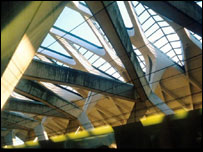
Lyon Saint-Exupery airport was named in honour of the novelist
|
A tough, straight-talking man, Mr Bianco told me angrily he would clear his name.
One person who did believe him was a professional diver from Marseille called Luc Vanrell.
A calm and methodical man, Mr Vanrell has been diving in these turquoise waters all his life.
He remembered that his father, also a diver, once told him of seeing a sunken aeroplane exactly where Mr Bianco found the bracelet.
Mr Vanrell successfully identified the plane of Saint-Exupery, but then he too found out what it was like to be at the wrong end of a campaign of press vilification, accused of faking evidence.
But finally, this April, the French government confirmed that the plane found by Mr Vanrell was indeed that of Saint-Exupery.
 |
 Branded a traitor, Saint-Exupery drank heavily, and even hinted at suicide Branded a traitor, Saint-Exupery drank heavily, and even hinted at suicide

|
The author's wealthy and influential family are still uncomfortable about the discovery, and many in the French political establishment are keen to suppress any discussion of the matter.
The reason?
Well, it could be because the presence of Saint-Exupery's plane so far from its planned route, with evidence of a vertical crash, lends credence to an uncomfortable hypothesis - that the war hero may have deliberately plunged his Lockheed Lightning aircraft into the Mediterranean Sea.
Flight ban
During World War II, France was split into factions, with the German-controlled Vichy government in France opposed by the so-called Free French, based in London.
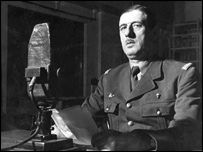
General Charles de Gaulle later became first president of the new Fifth Republic in France in 1959
|
Saint-Exupery was fighting as an officer in the Free French air force, but he distrusted the authoritarian leader, General Charles de Gaulle.
In 1943 de Gaulle paid the author back, by publicly implying that he suspected him of supporting the Germans. Saint-Exupery was banned from flying with the Free French air force.
It took the author eight months to get the flying ban overturned.
By now, the European war was approaching its climax, with D-Day
in the north, while Saint-Exupery's squadron was advancing from North Africa to Corsica.
Still branded a traitor, Saint-Exupery drank heavily, and even hinted at suicide.
|
I think he was suffering from depression, and hounded by politicians
Luc Vanrell
|
Here in Corsica, he was billeted in a villa at Erbalunga, a beautiful, ancient village on the sea's edge, now famous as an artists' colony.
On 30 July, Saint-Exupery went to the beach, and according to a local girl he met there, said: "Come for a swim with me, you never know, I might not be here tomorrow."
He took off early the next morning and was never seen again.
National hero
Ironically, after the war, the man who described France's wartime politicians as "a basket of crabs" was claimed by them as a unifying symbol, the acceptable face of the country's wartime record.
It is unlikely that we will ever finally know how Saint-Exupery died. His plane exploded when it crashed.
The diver Luc Vanrell is one of few in France inclined to voice publicly the theory that Saint-Exupery killed himself. But he believes that if the author did commit suicide, we should not think any the less of him.
"I think he was suffering from depression, and hounded by politicians," Mr Vanrell told me. "If he did decide to end it all by plunging into the sea, I think it was a courageous and even noble end."
As for the fisherman Jean-Claude Bianco, he went to sea last Sunday, but just to lay a wreath at the site where he found the identity bracelet of Antoine de Saint-Exupery.
From Our Own Correspondent was broadcast on Saturday, 7 August, 2004 at 1130 BST on BBC Radio 4. Please check the programme schedules for World Service transmission times.
|